The R1 Implementation Process — 5 Steps for Increased Adoption and Impact
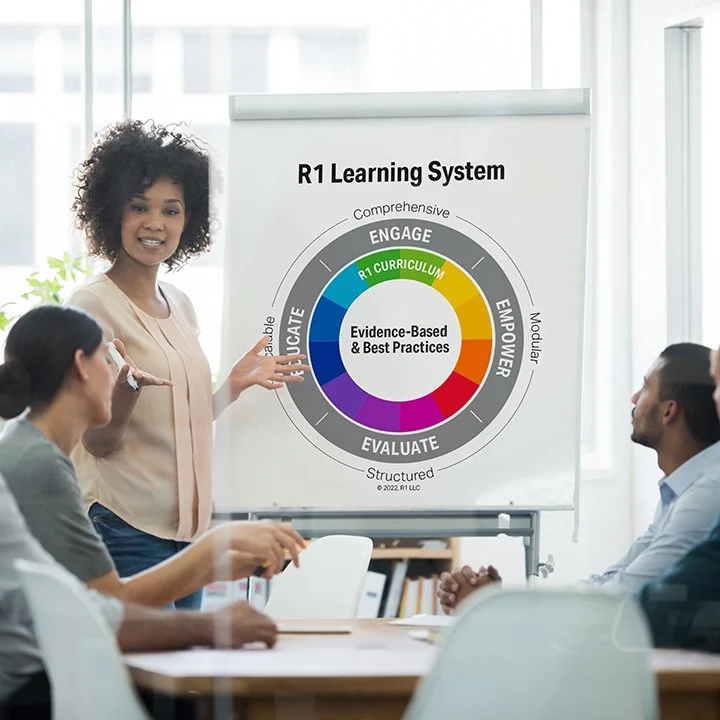
R1’s focus today is on implementation science and change management principles. I’m excited to share an important milestone: with the addition of the R1 Implementation Process, the R1 Learning System is now fully built out helping R1 scale with both small organizations and large multi-program and location enterprises.
It has been an adventure coming into the behavioral health field with the goal to effect outcomes through engagement and education. Over the past several years, we have intentionally built, tested, refined, and connected six distinct foundational components of the R1 Learning System:
R1 Content Structure (2018)
R1 Solutions Structure (2019)
R1 Engagement Process (2020)
R1 Learning Process (2021)
R1 Workforce Development Process (2024)
R1 Implementation Process (2026)
The R1 Learning System has been tested in a variety of settings, populations, and with practitioners at all levels of knowledge, skill, and experience. And now, as I’m often reminded by team members, mentors, and friends, R1 is fully ready to take off and impact an amazing number of people. With new features, oversight dashboards, expanded data analytics, and a growing library of evidence-based content, R1 Discover is ready to scale—from small organizations to large, multi-location enterprises.
One of our greatest lessons has been that great content and technology are still not enough. How a learning system is implemented ultimately determines how effectively it is integrated, adopted, used, and sustained. That lesson has been reinforced through our work on large and complex implementations with organizations such as the California Department of Corrections and Rehabilitation (CDCR), Pinnacle Health, Oregon Recovery and Treatment Centers, Sacramento County Jails, Mental Health America Indiana (MHAI), and many others nationally and in the UK. Through these experiences, change management and implementation science have become central to our own learning and evolution. They have taught us that implementation cannot be an afterthought—it must be an upfront and ongoing intentional process.
The R1 Implementation Process is now our number one priority. Our success, our customers’ success, and ultimately the success of the individuals and families we all serve depend on getting implementation right. The R1 Implementation Process brings together proven principles of implementation science and change management while keeping the process practical, simple, and adaptable to the fast-paced and constantly changing behavioral health environment. Building the R1 Learning tools, training, and technology were the first part of our journey. Implementing it successfully is our focus today.
Engagement — R1’s Engine for Change
Before we dive into our simple, five-step R1 Implementation Process, let’s start with what we believe is our differentiator, engagement. We assert that engagement is the engine that sparks, drives, and sustains change—and for us, engagement is always coupled with education. At every step of implementation, our goal is to educate, communicate, and create the energy and motivation needed to move people forward. That starts with helping stakeholders understand why change is needed, what we are implementing, how it will benefit them and the people they serve, and what role they play in making it successful. When people understand the purpose, see the value, and feel part of the process, they buy-in, bring their talents and creativity, and the momentum needed to turn implementation into lasting change. They are engaged in the process at every level.

Metrics Matter — Begin with the End in Mind
Another critical aspect of successful implementation is identifying, tracking, and reporting on the metrics and outcomes that matter most. Before any project begins, R1 works with customer stakeholders to answer two simple questions: 1) What difference are we trying to make, and 2) how will we measure it? R1 brings important learning measures to the table—including engagement, knowledge attainment, motivation, confidence, and readiness for change—but our measurement must extend beyond learning. Depending on the setting, outcomes might include readmissions, recidivism, grievances, disciplinary incidents, positive behaviors, emotional regulation, literacy and educational gains, work readiness, or vocational and digital skill attainment. Connecting R1 data with the outcomes that matter to programs, communities, payers, grant funders, and oversight organizations will be front and center in the next stage of the R1 journey.
The R1 Implementation Process Defined
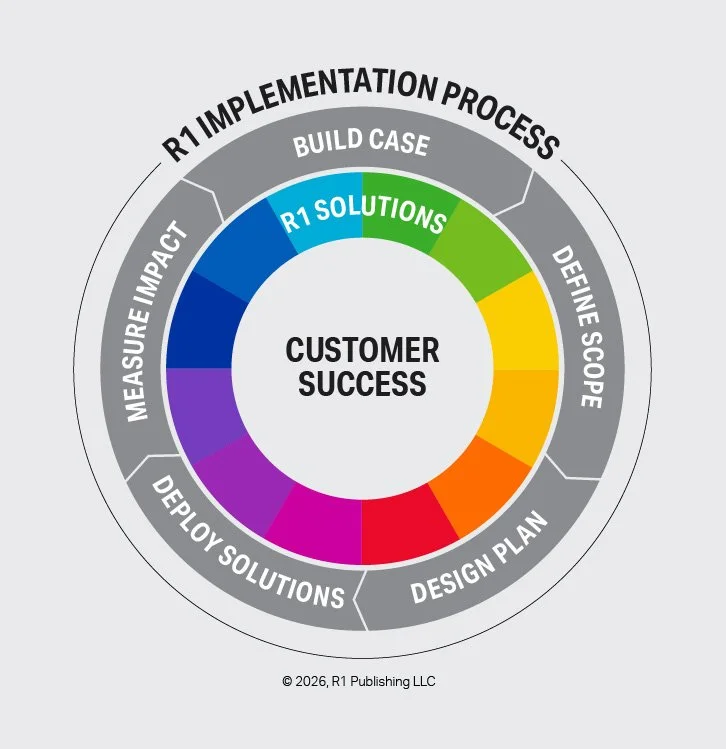
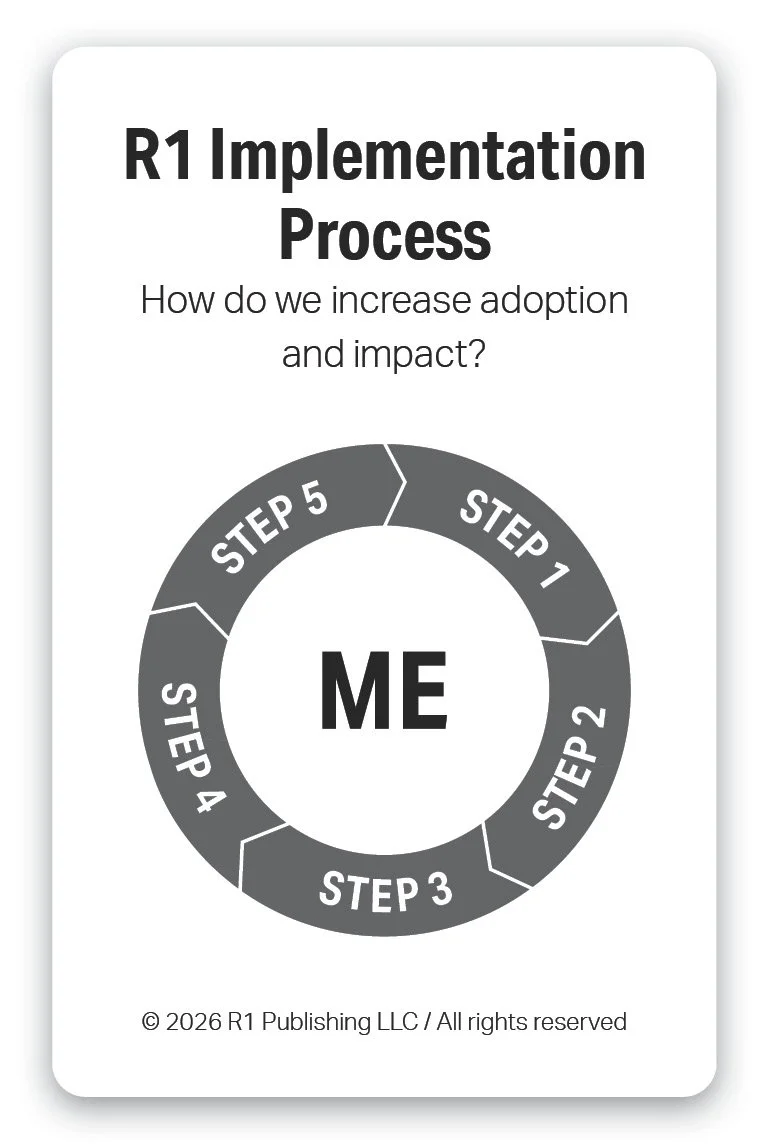
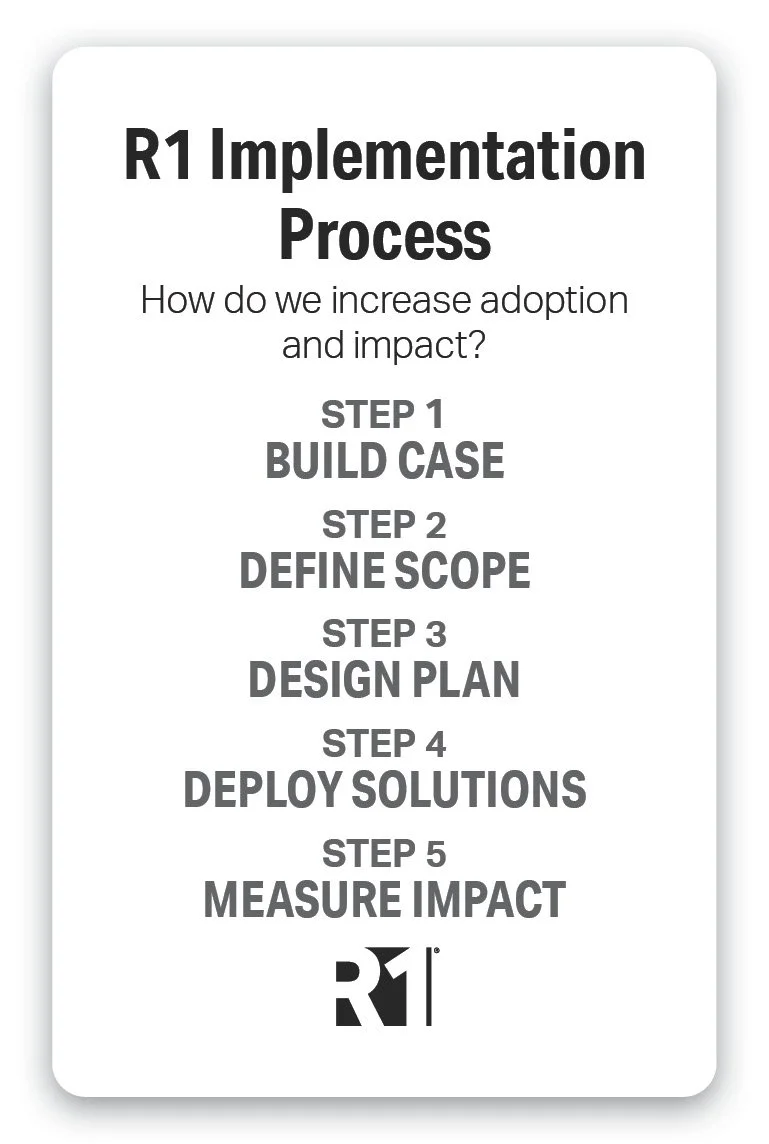
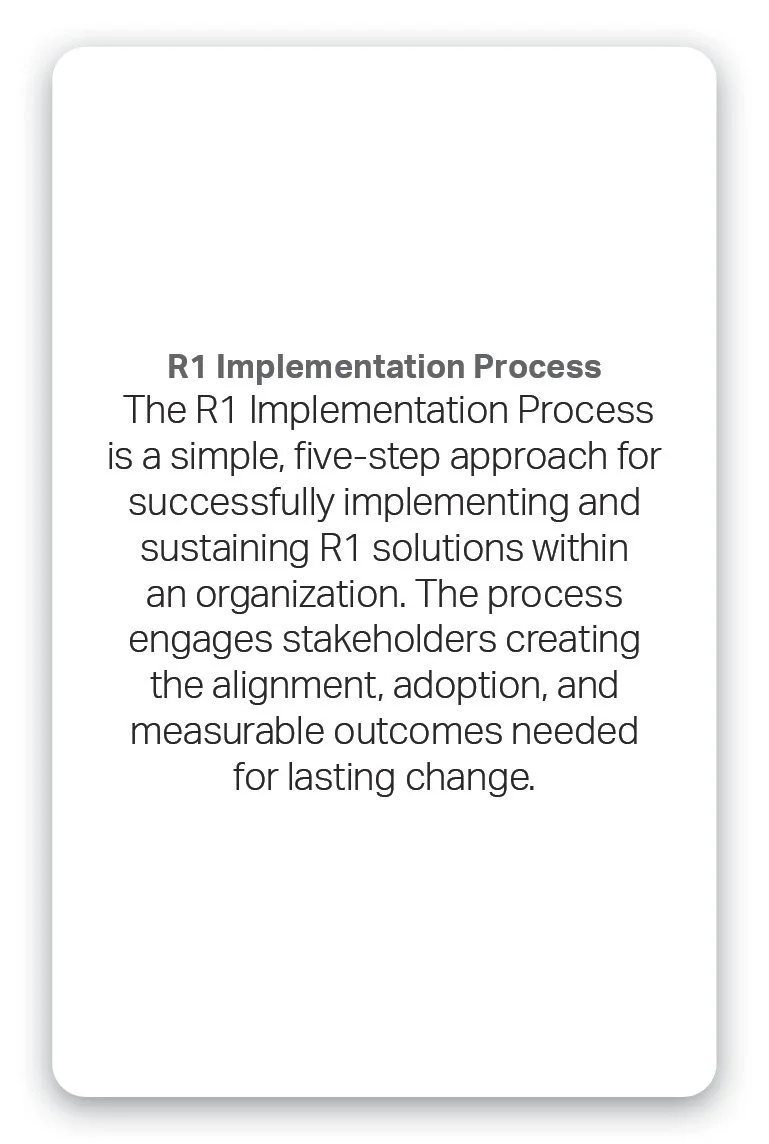
Definition: The R1 Implementation Process is a simple, five-step approach for successfully implementing and sustaining R1 solutions within an organization. The process engages stakeholders to build the business case, define the scope, design the plan, deploy solutions, and measure impact—creating the alignment, adoption, and measurable outcomes needed for lasting change.
5 Steps for Customer Success — Below highlights R1’s 5 Steps for how we work with our customers. Link to download a more detailed 1-page document for the R1 Implementation Process.
Step 1 — Build the Business Case
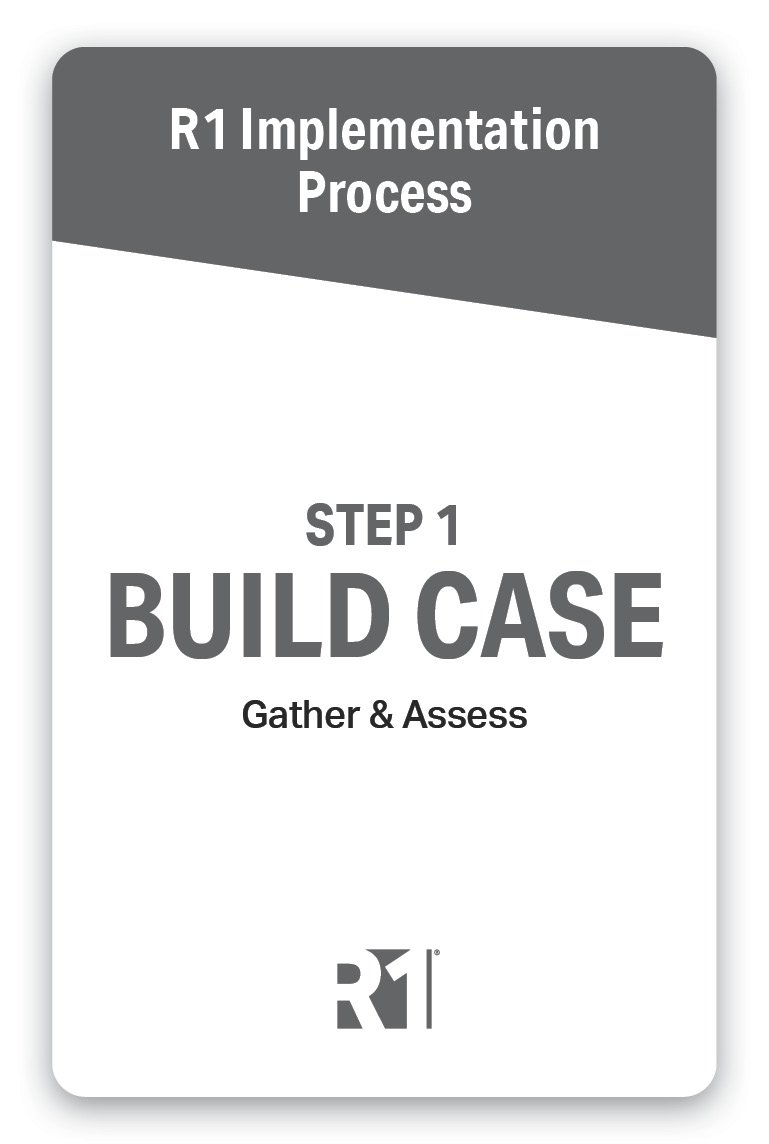
Action Steps:
Gain understanding about the organization (e.g., mission, culture, priorities, goals)
Identify needs, challenges, and opportunities
Clarify project scope (e.g., organization structure, workforce, census)
Define project goals and success measures
Quantify return on investment (ROI)
Deliverables:
Business Case
Key Performance Indicators (KPIs)
Step 2 — Define the Project Scope
Action Steps:
Identify key stakeholders and sponsors
Executive Sponsor
Project Lead
Educate and align leadership in business case, goals, and value
Confirm project scope and priorities
Define timeline, budget, and success measures
Deliverables:
Scope of Work (SOW) Project
Timeline & Deliverables
Success Measures
Leadership Alignment & Buy-in
Step 3 — Design the Project Plan
Action Steps:
Identify R1 champions and support teams
Develop implementation plan and communication strategies
Map R1 resources to existing programming (e.g., schedules, curriculum crosswalks)
Integrate with existing systems and workflows (e.g., EMRs, Case Management Systems)
Deliverables:
Training Schedule
Stakeholder Meeting Schedule
Adoption Dashboards
Engagement Metrics
Step 4 — Deploy the Solutions
Action Steps:
Configure R1 Discover, reporting dashboards, and ready solutions
Engage and train R1 trainers and champions
Engage and train workforce
Support engagement and adoption during rollout
Deliverables:
Scope of Work (SOW) Project
Timeline & Deliverables
Success Measures
Leadership Alignment & Buy-in
Step 5 — Measure and Evaluate Impact
Action Steps:
Measure outcomes
Evaluate adoption impact
Identify successes and areas for improvement
Celebrate, reward, and communicate successes
Optimize and scale
Deliverables:
Performance Metrics
Outcome Measurement
Optimization & Continuous Improvement Plan
Key Stakeholder Groups
Successful implementation begins with identifying and engaging the right stakeholders across the organization. Key stakeholders provide the leadership, expertise, influence, and day-to-day involvement needed to align goals, guide decisions, support training and technology adoption, address barriers, and sustain change. Clearly defining stakeholder roles and responsibilities helps create shared ownership, accountability, and momentum throughout the R1 Implementation Process. Several key stakeholder groups to identify, build, engage, and align:
Leadership Team (Executive Sponsor)
Project Lead and Team
Organizational Stakeholders (Compliance, Technology, Training, Communications, Grants)
Community Stakeholders & Partners
R1 Champion Team, Location and/or Program, R1 Subject Matter Expert (SME)
R1 Train-the-Trainer Team
R1 Super Users – Both digital and hands-on tools
Questions to Explore
Answer these questions for yourself or with your team:
What did your find most helpful about this post? Explain.
How does your organization currently implement new solutions? Do you use similar steps?
Which steps of the R1 Implementation Process are strengths for your organization? Explain.
Which of the steps do you find most challenging? Are these steps difficult for every part of your organization or just specific locations or programs?
What is one thing you or your staff can do to increase adoption of new policies, tools, or technology solutions given what you’ve learned.
What is your major learning or takeaway from this post?
R1 Resource that Support the R1 Implementation Process

References
Markus, M. L. (2004). Technochange management: Using IT to drive organizational change. Journal of Information Technology, 19(1), 4–20. https://doi.org/10.1057/palgrave.jit.2000002
Baldwin, T. T., & Ford, J. K. (1988). Transfer of training: A review and directions for future research. Personnel Psychology, 41(1), 63–105. https://doi.org/10.1111/j.1744-6570.1988.tb00632.x
Damschroder, L. J., Reardon, C. M., Widerquist, M. A. O., & Lowery, J. (2022). The updated Consolidated Framework for Implementation Research based on user feedback. Implementation Science, 17, 75. https://doi.org/10.1186/s13012-022-01245-0
Hanelt, A., Bohnsack, R., Marz, D., & Antunes Marante, C. (2021). A systematic review of the literature on digital transformation: Insights and implications for strategy and organizational change. Journal of Management Studies, 58(5), 1159–1197. https://doi.org/10.1111/joms.12639
Powell, B. J., Waltz, T. J., Chinman, M. J., Damschroder, L. J., Smith, J. L., Matthieu, M. M., Proctor, E. K., & Kirchner, J. E. (2015). A refined compilation of implementation strategies: Results from the Expert Recommendations for Implementing Change (ERIC) project. Implementation Science, 10, 21. https://doi.org/10.1186/s13012-015-0209-1
Weiner, B. J. (2009). A theory of organizational readiness for change. Implementation Science, 4, 67. https://doi.org/10.1186/1748-5908-4-67
Herschell, A. D., Kolko, D. J., Baumann, B. L., & Davis, A. C. (2010). The role of therapist training in the implementation of psychosocial treatments: A review and critique with recommendations. Clinical Psychology Review, 30(4), 448–466. https://doi.org/10.1016/j.cpr.2010.02.007
Mausbach, B. T., et al. / Mental Health Technology Transfer Center implementation work (2022). Applying implementation science in mental health services: Technical assistance cases from the Mental Health Technology Transfer Center (MHTTC) Network. Administration and Policy in Mental Health and Mental Health Services Research.
Copyright 2026 R1 Learning LLC / All Rights Reserved. Use of this article for any purpose is prohibited without permission.
Here are a few ideas to help you learn more about R1 and engage others on this topic:
Share this blog post with others. (Thank you!)
Start a conversation with your team. Bring this information to your next team meeting or share it with your supervisor. Change starts in conversations. Good luck! Let us know how it goes.
Visit R1LEARNING.com to learn more about R1, the Discovery Cards, and how we’re creating engaging learning experiences through self-discovery.